Abstract
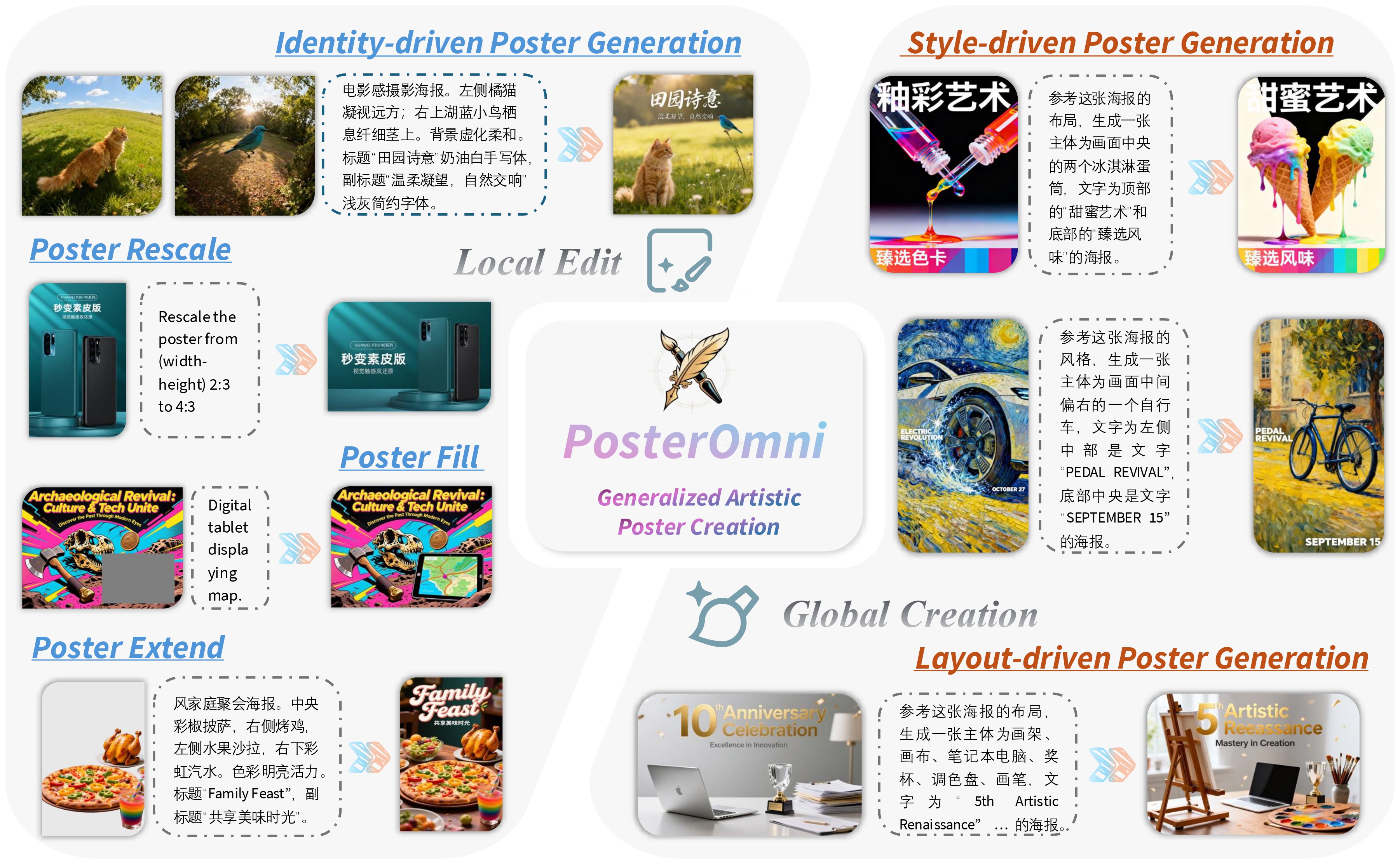
Image-to-poster generation is a multi-dimensional process coupling entity-preserving local editing (such as rescaling, filling, and extending) with concept-driven global creation (like layout and style transfer).
We propose PosterOmni, a generalized framework that unifies these regimes via an efficient data–distillation–reward pipeline. Our approach involves constructing multi-scenario datasets covering six task types, distilling knowledge from specialized experts, and applying Unified Reward Feedback to align outcomes with aesthetic preferences. Extensive experiments show that PosterOmni significantly outperforms existing baselines in both fidelity and design quality.
Interactive examples showcasing PosterOmni's capabilities across diverse poster generation scenarios.
Capabilities
Diverse Poster Creation Tasks
1
Local Editing Precision
Performs precise local adjustments including extending, filling, rescaling, and identity-driven generation while preserving the original subject.
2
Global Creation Reasoning
Handles abstract high-level tasks such as layout-driven and style-driven generation, ensuring aesthetic coherence across the entire poster.
3
Unified Framework
Seamlessly integrates multiple editing and generation capabilities into a single model without switching pipelines.
Data Engineering
Automated Data Construction
1
Prompt & Image Generation
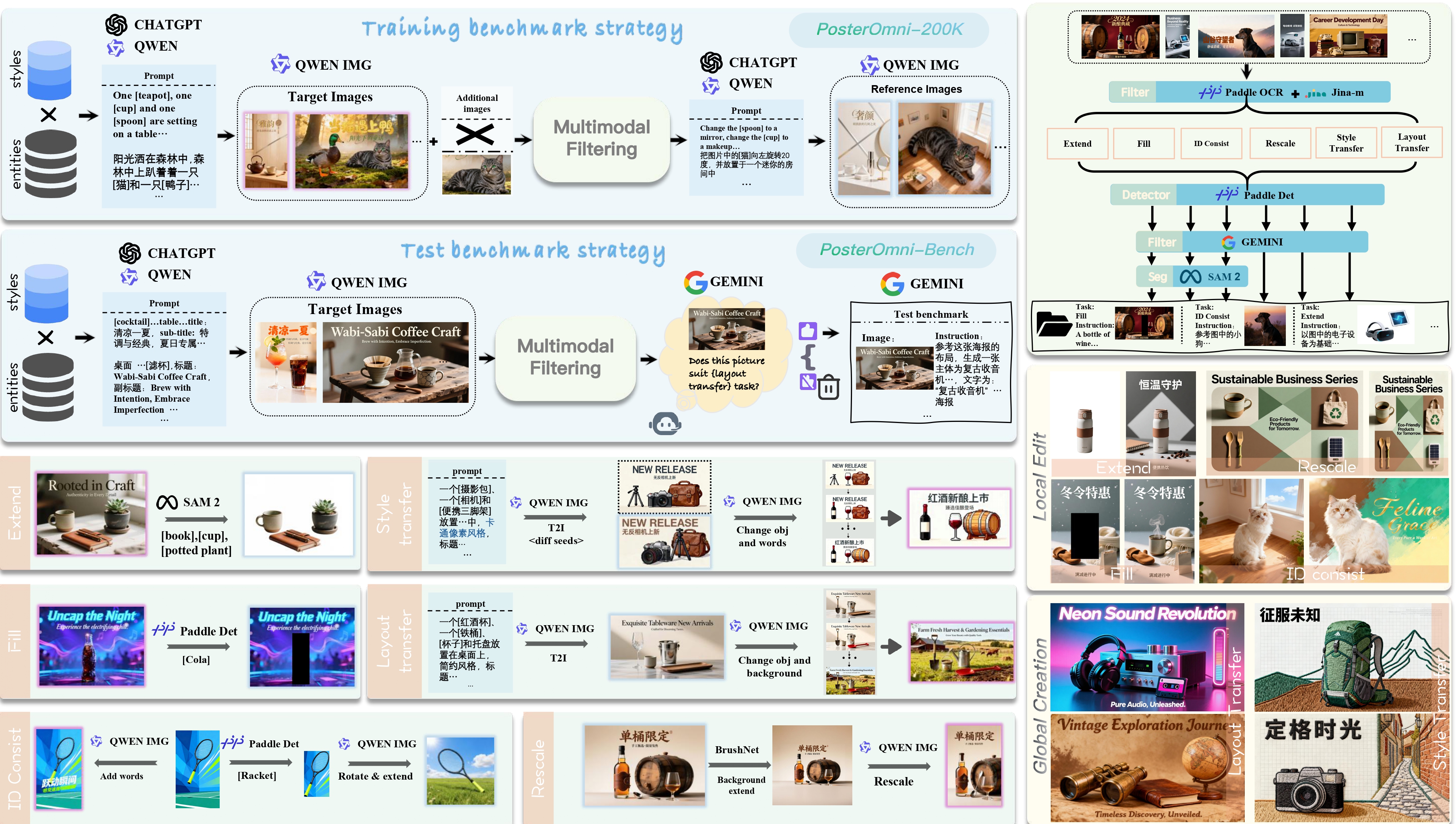
Leverages GPT-4 and Qwen to generate diverse, structured prompts and initial images covering various themes.
2
Multimodal Filtering
Employs OCR and VLM-based filtering to ensure textual correctness and layout-content consistency.
3
Task-Specific Construction
Automatically synthesizes paired data for 6 specific tasks using tools like SAM-2 and BrushNet.
Methodology
Progressive Training Pipeline
1
Task-Specific SFT
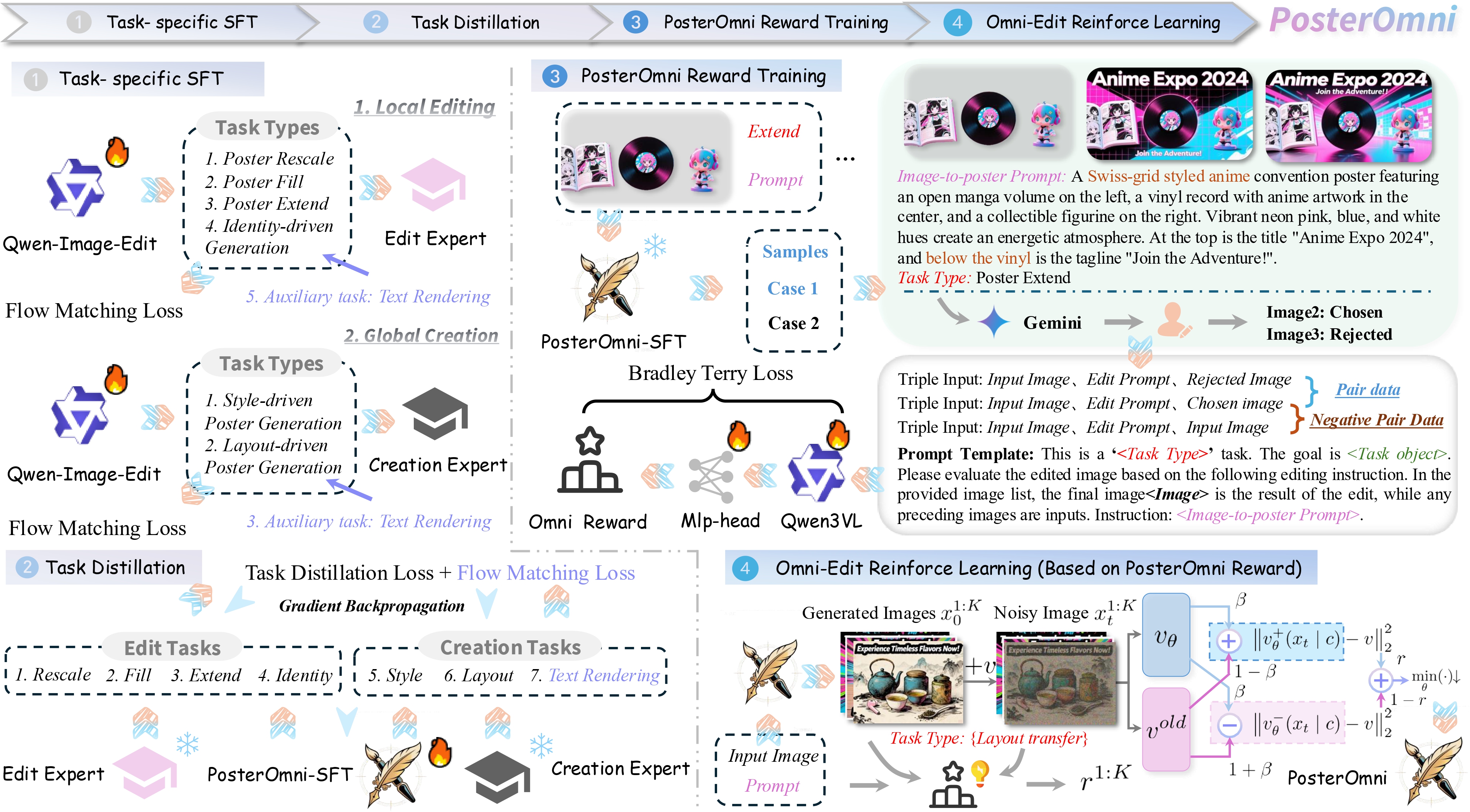
Trains specialized experts for local editing and global creation to ensure high fidelity in distinct domains.
2
Task Distillation
Distills knowledge from experts into a unified student model, merging pixel precision with aesthetic understanding.
3
Unified Reward Feedback
Aligns with human preferences using a reward model that evaluates both aesthetic appeal and instruction adherence.
4
Omni-Edit RL
Uses Reinforcement Learning to refine generation quality and align it with professional design standards.
Table 1: Quantitative comparison results on PosterOmni-Bench. Gold indicates the best performance, and Blue indicates the second best.
Head-to-head comparison showcasing PosterOmni's Overall Preference win rates against state-of-the-art baseline models based on comprehensive human expert evaluation.
PosterOmni
vs
FLUX.1 Kontext
PosterOmni
vs
Qwen-Image-Edit
PosterOmni
vs
UniWorld-V2
PosterOmni
vs
Seedream-3.0
PosterOmni
vs
Seedream-4.0
Human experts evaluated PosterOmni against baseline models across multiple dimensions.
Results demonstrate PosterOmni's superior performance in aesthetic quality and task alignment.
 1HKUST(GZ)
 2Meituan

 After
Rescaling
After
Rescaling

 After
Rescaling
After
Rescaling

 After
Extending
After
Extending

 After
Layout-driven
After
Layout-driven

 After
Layout-driven
After
Layout-driven

 After
Style-driven
After
Style-driven

 After
Extending
After
Extending

 After
Id-driven
After
Id-driven

 After
Filling
After
Filling

 After
Rescaling
After
Rescaling